
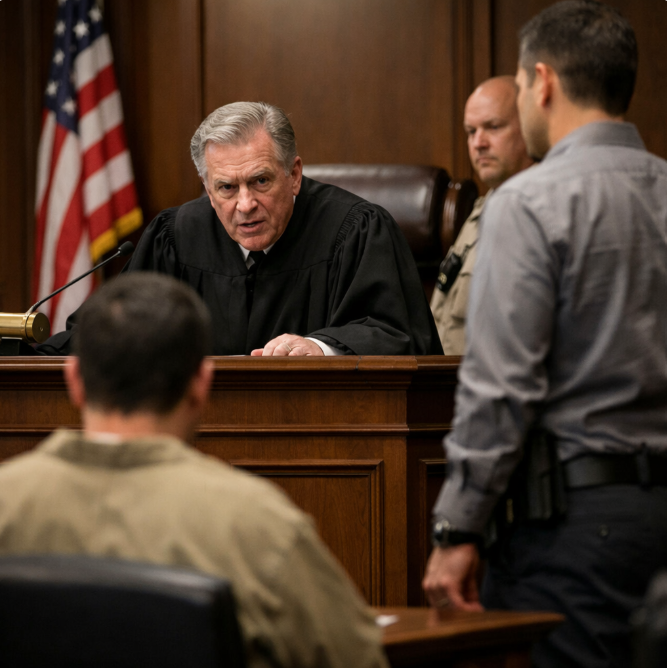
The Name That Wasn’t His
The courtroom had reached that quiet point where everything felt decided. Weeks of testimony had narrowed the case to a final moment. Jurors sat upright, prepared to hear the verdict. Attorneys stood with controlled composure. Spectators leaned forward, aware that a single word could change the course of a life.
At the defense table, the defendant remained calm but tense beneath the surface. He had listened to every argument, every witness, every objection. Now, he waited.
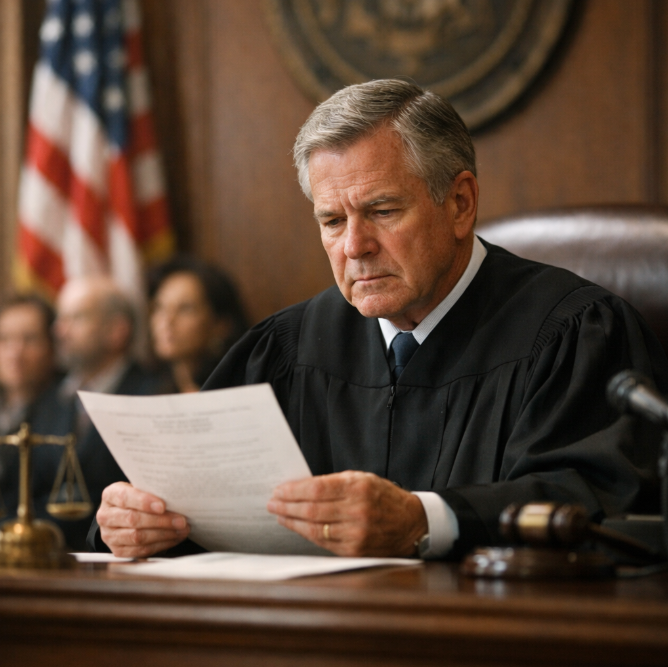
The judge unfolded the verdict form and adjusted his glasses.
“The court finds Michael Carter—”
The defendant’s head snapped up.
His name was not Michael Carter.
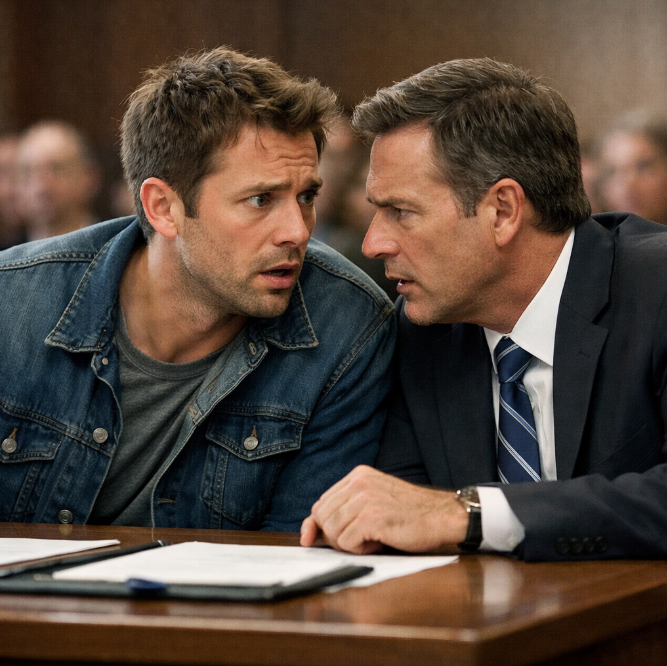
He leaned urgently toward his attorney. “That’s not my name.”
The attorney’s expression tightened. He glanced at the paperwork, then at the judge, unsure whether this was a clerical mistake or something more.
The judge paused deliberately.
He looked directly at the defendant.
“I know,” he said evenly.
A ripple of confusion passed through the courtroom.
When a Name Changes Everything
Silence deepened. The jurors exchanged uncertain looks. The prosecution team stiffened. The spectators in the gallery sensed something unusual was unfolding.
The judge rested his hands on the bench.
“Stand up, Mr. Carter.”
The defendant remained seated.
A slow camera of attention moved across the courtroom as heads turned toward the public gallery.
In the third row, a man who had been sitting quietly throughout the trial froze.
He had attended each session without drawing attention. He had listened carefully, never speaking, never reacting dramatically. To most observers, he appeared to be an interested spectator.
Now all eyes were on him.
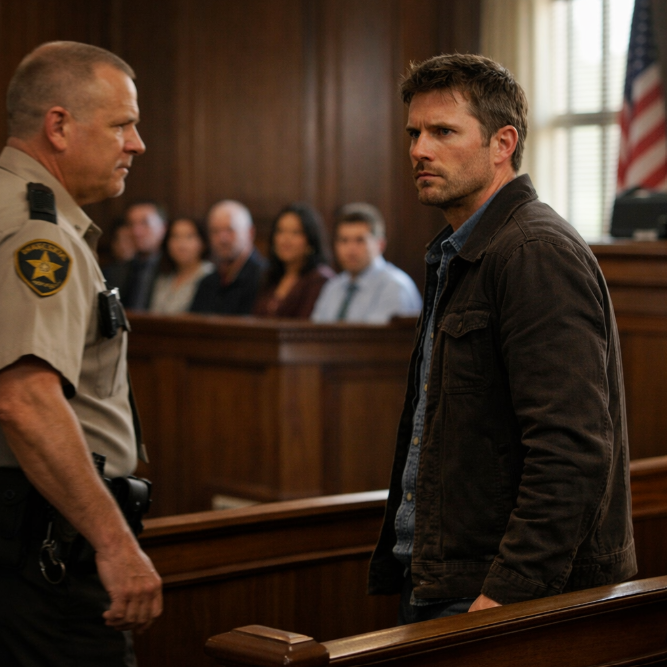
The bailiff stepped closer to the aisle.
The man hesitated, then rose slowly.
The room felt smaller.
The defendant at the defense table stared in disbelief. His attorney stood carefully, uncertain how to respond.
The judge’s voice remained calm and controlled.
“Michael Carter, please approach the front of the courtroom.”
Gasps echoed softly.
The Hidden Detail
The prosecution attorney stepped forward. “Your Honor, this case concerns the defendant at the defense table.”
The judge nodded slightly. “The individual at the defense table has been identified under the name provided at arrest. However, new documentation submitted this morning raises questions regarding identity.”
The courtroom absorbed the statement.
The defense attorney spoke cautiously. “Your Honor, are you suggesting mistaken identity?”
“I am suggesting,” the judge replied, “that the identity presented to this court may not align with verified records.”
The man from the gallery stood motionless near the aisle. His earlier calm had shifted to visible tension.
The judge continued.
“Fingerprint records reviewed late last night indicate that the name Michael Carter corresponds not to the defendant seated here, but to the individual now standing in the gallery.”
The defendant’s face showed confusion and relief at once.
The prosecution team reviewed their files rapidly. The jurors leaned forward, aware that the structure of the trial had shifted.
Trials rely heavily on accurate identification. Names are not minor details. They anchor evidence, testimony, and responsibility.
If identity is uncertain, everything connected to it must be examined.
When Identity Is Questioned
The judge addressed the man in the gallery.
“State your name for the record.”
He hesitated before answering.
“Michael Carter.”
The words seemed heavier than before.
The courtroom filled with murmurs.
The defendant’s attorney looked stunned. “Your Honor, my client has consistently maintained his identity.”
The judge nodded. “The documentation suggests that the individual seated at the defense table provided identification matching records belonging to Mr. Carter.”
The implications were clear.
Related Stories:
Someone had assumed another person’s name.
The prosecution attorney spoke carefully. “This information was not available during the initial proceedings.”
“That is correct,” the judge replied. “It surfaced during final verification of records.”
The jurors exchanged thoughtful glances. They understood that the case they had followed closely was now more complex.
The defendant spoke quietly. “I told you my name wasn’t that.”
The judge regarded him thoughtfully.
“This court will pause before any verdict is finalized.”
The gavel did not strike. Instead, the judge allowed silence to underscore the seriousness of the moment.
The Importance of Verification
Courtrooms operate on procedure and verification. Identification confirms responsibility. Responsibility shapes verdicts.
When the judge called a name that did not belong to the defendant, it was not a mistake. It was a test of record accuracy.
By observing the reaction, the court confirmed what the paperwork suggested.
The man from the gallery had attended the trial carefully. His presence had gone unnoticed because spectators are common in public proceedings. Yet fingerprint comparisons connected him to key documents originally believed to belong to the defendant.
The defense attorney addressed the court. “Your Honor, this revelation fundamentally alters the case.”
“Yes,” the judge replied. “Which is why the court will not proceed without clarity.”
The prosecution nodded reluctantly. “We request immediate review of identification records.”
The judge agreed.
“This court values accuracy above speed. No verdict will be entered until identity is confirmed beyond doubt.”
The jurors were instructed to remain impartial while the matter was reviewed. Spectators observed quietly, aware they had witnessed something extraordinary.
Not chaos.
Verification.
When Procedure Protects Justice
As the courtroom session paused, the significance of the moment became clear.
A single name had revealed a larger issue.
The judge’s deliberate pause demonstrated an essential principle.
Justice requires confirmation.
Assumptions can mislead. Documents can be misfiled. Names can be misused.
But when the system slows down to verify, fairness is preserved.
The defendant at the table sat quietly, processing what had just occurred. The man from the gallery remained under supervision, no longer anonymous.
The trial had not ended.
It had deepened.
Why This Moment Matters
This courtroom event highlights important principles:
• Accurate identification is central to fair trials
• Verification of records protects all parties
• Judges must remain attentive to detail
• Transparency strengthens public confidence
• A pause in proceedings can prevent injustice
• Procedure exists to safeguard truth
The moment the judge called the wrong name was not an error.
It was a correction.
By acknowledging uncertainty before finalizing a verdict, the court upheld the highest standard of integrity.
Because justice is not simply about reaching a decision.
It is about ensuring the decision belongs to the right person.
And sometimes, that begins with calling the right name.
You have not enough Humanizer words left. Upgrade your Surfer plan.
[…] The Judge Knew […]
I thought the story was great