
Courtrooms are built on procedure, not emotion, instinct or even memory. Procedure is what matters. In a courtroom facts are only as strong as the path they took to get. That afternoon the path became the story.
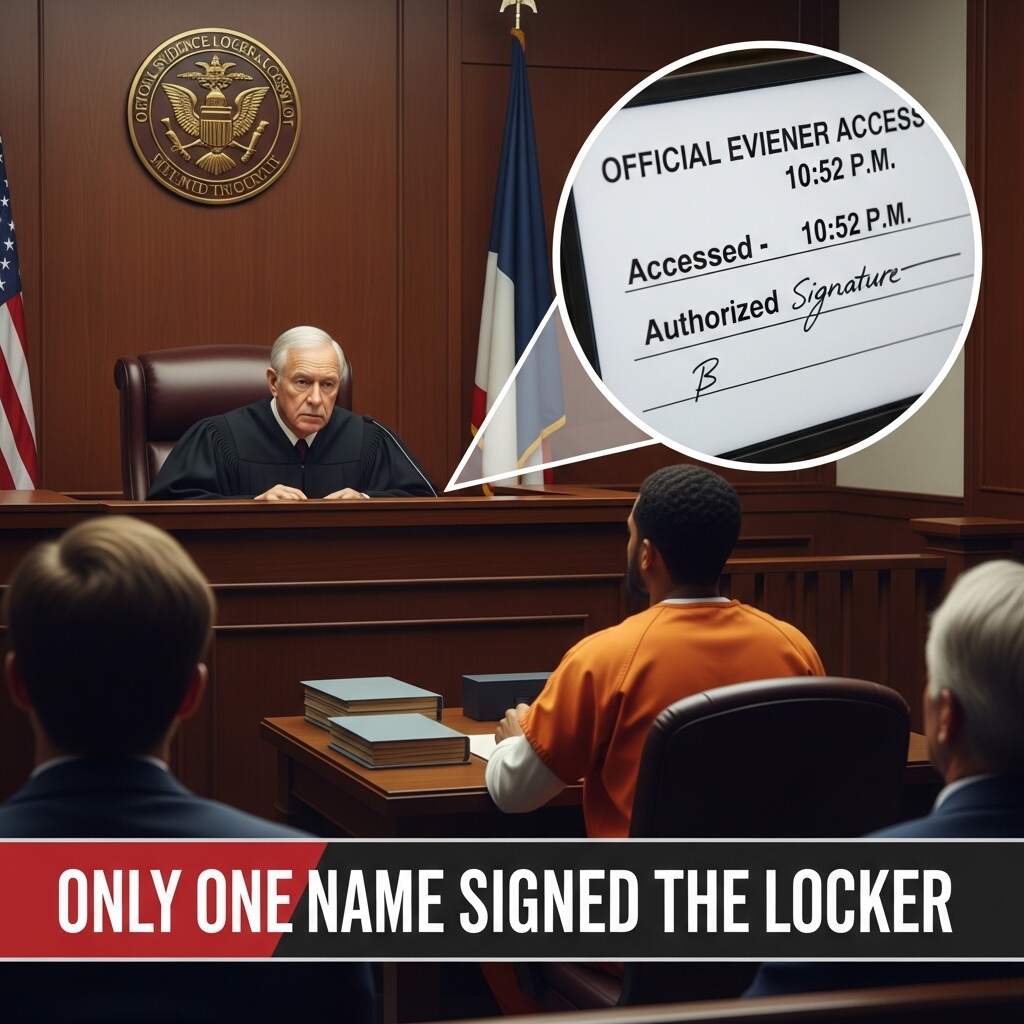
The defendant sat at the defense table wearing a jumpsuit with his hands folded neatly in front of him. He had learned that stillness can be powerful. Not reacting is sometimes louder than objecting. The judge adjusted his glasses. Glanced toward the prosecution table. “Before we proceed ” he said evenly “I want the evidence locker log read into the record.”
The request sounded routine, almost administrative. The jurors shifted slightly in their seats some stretching their fingers others preparing their pens. Evidence logs are rarely dramatic; they are checkpoints. Dates, times, names. A timeline confirming that items have been handled properly.
The clerk began scrolling through the archive. The room was quiet except for the sound of keys and the distant hum of the HVAC system. Then she stopped scrolling. Her brow tightened slightly as she cleared her throat. “Locker accessed at 10:52 p.m.” A quiet murmur spread across the jury box. 10:52 P.m.
Was later than expected.
The evidence in question, a sealed envelope containing a flash drive had been introduced the next morning. The prosecution had built much of its argument around its contents claiming it contained communication logs that tied the defendant to a coordinated transfer the night before his arrest. The timeline had seemed airtight until now.
The defendant slowly lifted his head not sharply or defensively but deliberately. His voice when he spoke was low and controlled. “That locker requires two signatures.” The prosecutor stiffened instantly. The judge leaned forward. “Explain ” he said. The defendant kept his eyes on the judge. “Any after-hours access requires authorization. That’s protocol. One supervising. One secondary witness. It’s in the department manual.”
The defense attorney nodded quietly beside him. The clerk began scrolling. The courtroom had changed temperature. “Clerk read the access entry ” the judge said firmly. She. Read carefully. “Access time: 10:52 p.m. Primary authorization: Detective Roland Hayes.” She paused. The judges voice sharpened. “Clerk read the name.”
Silence filled the room.
The clerk scrolled again. “There is no authorization listed.” The words settled like weight. Chain of custody requires two signatures, not one. Evidence removed without documentation can be challenged, excluded or invalidated. The prosecutor rose immediately. “Your Honor that may simply be an oversight—” “Sit ” the judge said without raising his voice.
The jurors exchanged glances. This was no longer about what was on the flash drive; it was about how it got. The defense attorney stood slowly. “Your Honor we request the surveillance footage for the evidence locker corridor at 10:52 p.m.” The judge nodded. “Granted.” The prosecutor said nothing. That silence mattered.
The footage showed the hallway at 10:51 p.m. The corridor was empty. At 10:52 Detective Roland Hayes appeared in frame scanned his badge and stepped inside. The camera angle did not show the interior of the locker room. Thirty-seven seconds later he exited, alone. The jurors leaned forward unconsciously. The defense attorney paused the video. “Is there any indication of a badge scan?” he asked.
The clerk checked the log. “No.”
The prosecutor rose again his voice measured. “Your Honor officers sometimes complete verification verbally if another authorized supervisor is present off-camera.” The judge turned toward him. “Was one ” The prosecutor hesitated. “I would need to confirm.” The hesitation was louder than the answer.
The judge turned back to the clerk. “Confirm whether Detective Hayes submitted a follow-up affidavit explaining single-person access.” The clerk searched. “No such affidavit is attached.” The courtroom felt heavier now. The jurors attention had shifted from the defendant to the prosecution table.
The defense attorney approached the bench. “Your Honor, without a signature or documentation of emergency override this access violates departmental procedure. The integrity of the evidence cannot be guaranteed.” The prosecutor spoke carefully. “The evidence was not altered.” The judges eyes sharpened. “Can you prove that?” Silence followed, because proving absence of alteration requires proof of custody and custody had just fractured.
The flash drive was central to the prosecutions timeline. If it had been accessed alone without documentation and without a witness then something happened that shouldn’t have. Even if nothing was changed the possibility alone introduced doubt..
Doubt is powerful.
The judge leaned back slowly. “Detective Hayes will be recalled ” he said. The courtroom shifted again. The prosecutions confidence was no longer visible. When Hayes returned to the stand he appeared composed but not comfortable. “Why did you access the locker at 10:52 p.m.?” the judge asked. “To verify the evidence inventory ”
Hayes replied.
The defense attorney approached slowly. “Detective did you remove the flash drive from the locker?” “Yes.” “For how long?” ” forty seconds.” “Did you plug it into any device?” “No.” “Can you prove that?” The question hung, because absence of proof is not proof of absence.
The judge addressed the court. “Chain of custody is not decorative; it exists to prevent this ambiguity.” The prosecutor did not argue further because the log showed one name, one badge and one access at 10:52 p.m.
The judge ordered a review of the locker access procedures. The admissibility of the flash drive would be decided after arguments were submitted. The courtroom session ended quietly with no shouting or dramatic collapse a quiet recognition that the path evidence takes matters as much, as the evidence itself.
As the defendant was escorted out he kept his posture steady. Sometimes innocence isn’t proven by what’s found; sometimes its revealed by what should never have happened. One name signed the locker and that was enough to change everything.
Part 2 – A Glimpse
The courtroom started up again the morning with a different kind of feeling in the air.
Detective Hayes sat back on the stand he was not confident like before he was just being careful. They had looked at the access logs overnight. They checked the badge scans, device connections and even what was happening on the network in the evidence processing room.
The defense team did not rush into anything.
They asked one question that changed everything.
“Detective, was that flash drive ever connected to a department computer when it was not a review time?”
Detective Hayes hesitated.
The courtroom felt it too.
The IT supervisor was called next to the stand. He was calm and technical and precise.
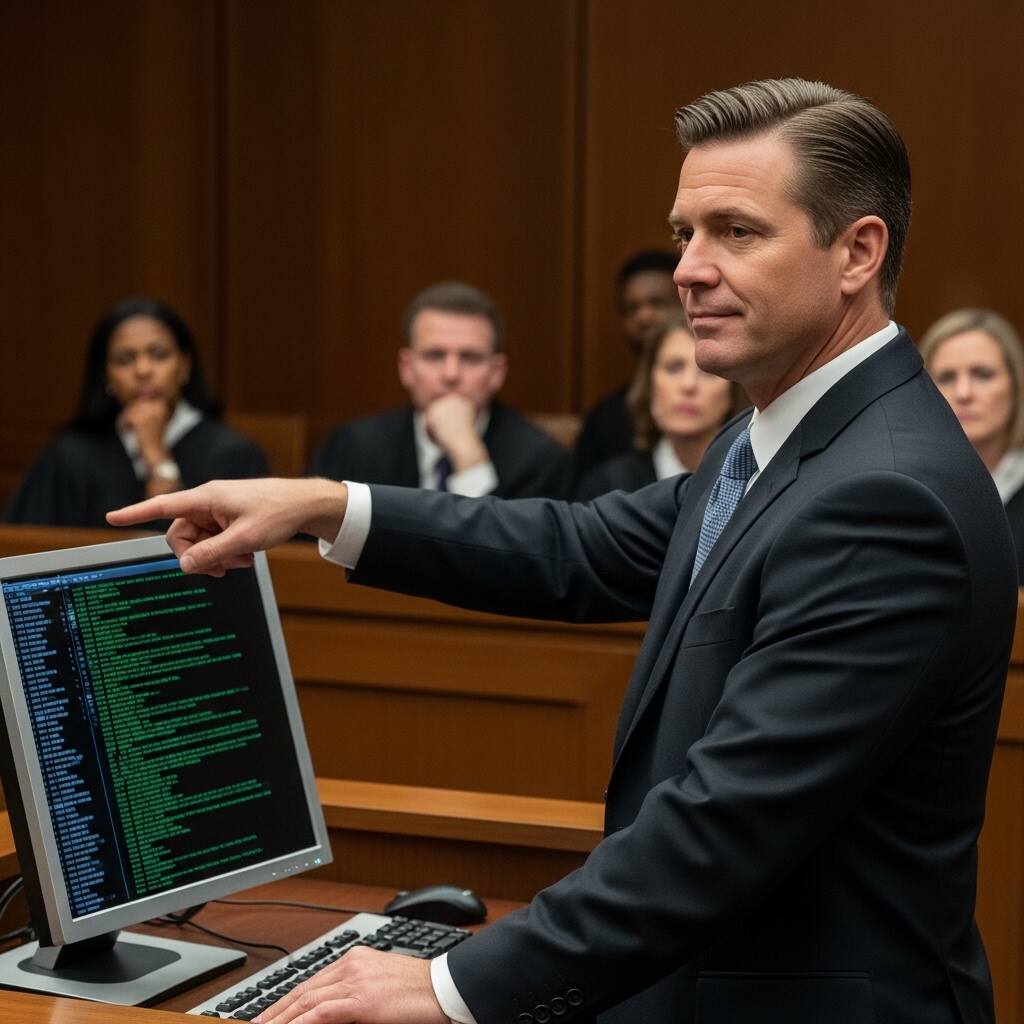
At 10:53 p.m. Which was one minute after the locker was accessed a computer in the evidence room showed that a device was connected. The ID number of the device was the same as the flash drive that was entered into evidence.
The jurors looked at the screen in front of them.
The device was connected for 28 seconds.
There was no review scheduled at that time.
No one had filed for authorization to access the device.
The prosecutor stood up. Objected, but he did not say it very loudly.
The defendant did not react to this information.
The question now was not about whether the locker needed two signatures to be opened.
The question now was why the flash drive was opened all.
If something was added to it or removed from it or just looked at without making a record of it.
The judge leaned forward slowly.
“Detective ” he said in a voice “what exactly did you look at on the computer at 10:53 p.m.?”
Detective Hayes did not have an answer ready.
Everyone, in the room knew it.
That secpnd signoger was GOD himself
Definitely