
Courtrooms are built on documentation.
Logs are important.
Reports are crucial.
Timestamps matter.
When something is written down it carries weight. When something is digitally recorded it feels like the truth.
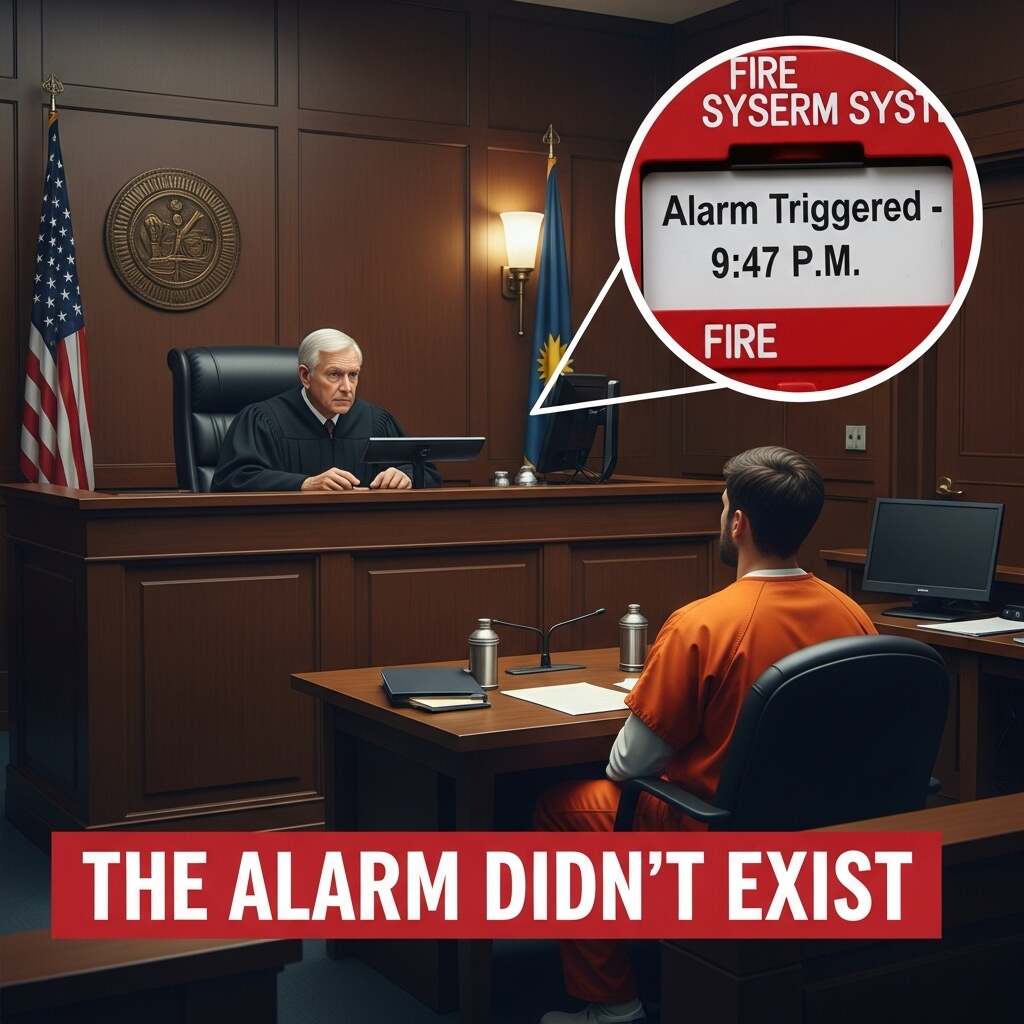
The prosecution leaned heavily on the fire alarm log.
According to their case the alarm triggered at 9:47 p.m. The night of the incident.
The alarm supposedly caused confusion, evacuation and a narrow window in which the defendant allegedly accessed storage and removed sensitive materials.
It was a story.
It was logical.
It was like a movie.
That was the problem.
The defendant sat at the defense table in a jumpsuit his posture steady.
He had barely reacted during most of the trial.
Witnesses had described smoke, panic, sirens and emergency vehicles arriving.
But when the judge asked for the fire alarm log to be read into the record something changed.
The judge said evenly “Clerk, read the alarm activation record for March 12th.”
The room quieted.
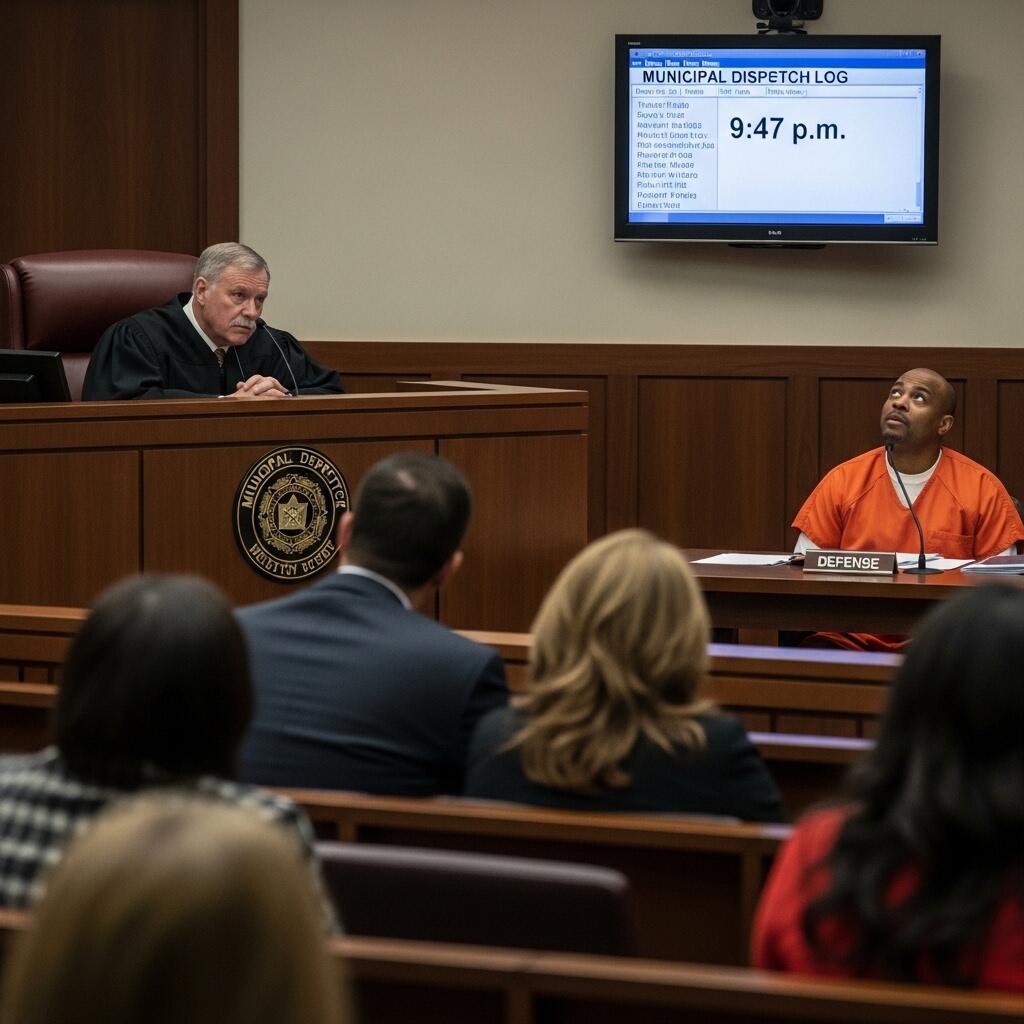
The clerk adjusted her glasses. Pulled up the municipal safety log.
Her voice was clear.
“Fire alarm triggered at 9:47 p.m.”
A quiet murmur spread across the jury.
9:47 P.m.
The prosecution nodded slightly as if reinforcing something already proven.
At the defense table the defendant lifted his head.
Not abruptly.
Not emotionally.
Sharply enough to show attention.
His voice when he spoke was low and controlled.
“That building doesn’t have alarms after renovation.”
The prosecutor froze.
The jurors stopped writing.
The judge leaned forward slowly.
“Explain ” he said.
The defendant didn’t look at the jury.
He didn’t look at the prosecutor.
“The entire alarm system was removed during the renovation last fall. It hasn’t been operational since November.”
Silence expanded across the room.
The prosecution’s expression hardened.
“That’s incorrect ” the prosecutor said quickly. “City records show activation.”
The judge turned to the clerk.
“Clerk… when were they removed?“
The question shifted the ground beneath the case.
Renovation Records
The clerk began searching through permits and building inspection logs.
The room felt suspended in something than tension.
Because if the defendant was correct. If the building had no alarm system at the time. Then the prosecution’s timeline collapsed immediately.
After a moment the clerk spoke carefully.
“Building permit for alarm system removal approved October 18th. Inspection signed November 3rd confirming deactivation.”
The jury reacted visibly.
One juror leaned forward.
Another exchanged a look with the person beside her.
The judge’s voice was steady but sharper now.
“Was a system installed afterward?”
The clerk scanned again.
“No record of reinstallation.”
The prosecutor stood quickly.
“Your Honor the activation log came directly from the fire department dispatch system.”
The judge’s eyes narrowed slightly.
“Which system?”
” emergency response.”
The judge leaned back.
“Then we are no longer discussing a building alarm. We are discussing a dispatch report.”
Those are not the same thing.
What Triggered the Dispatch?
The prosecution had framed the 9:47 p.m. Alarm as automatic. A sensor triggered by smoke inside the building.
If the building had no sensors then something else must have initiated the emergency response.
The defense attorney stood calmly.
“Your Honor we request the original dispatch call audio.”
The prosecutor hesitated.
The judge nodded.
“Granted.”
Minutes later the courtroom listened to the recording.
Static.
Background noise.
A voice.
Breathing heavily.
“There’s smoke coming from the east side entrance ” the caller said.
“Did you pull the fire alarm?” the dispatcher asked.
“No it just started going off.”
The jurors shifted.
Because now there was another contradiction.
The caller claimed the alarm was sounding.
The building had no active alarm system.
The judge turned to the clerk.
“Is there any record of an alarm pull station remaining in the building after renovation?”
The clerk checked.
“All internal pull stations were removed. Temporary signage was installed instructing occupants to call emergency services directly.“
The prosecutor’s posture changed.
The case was bending.
The Physical Layout
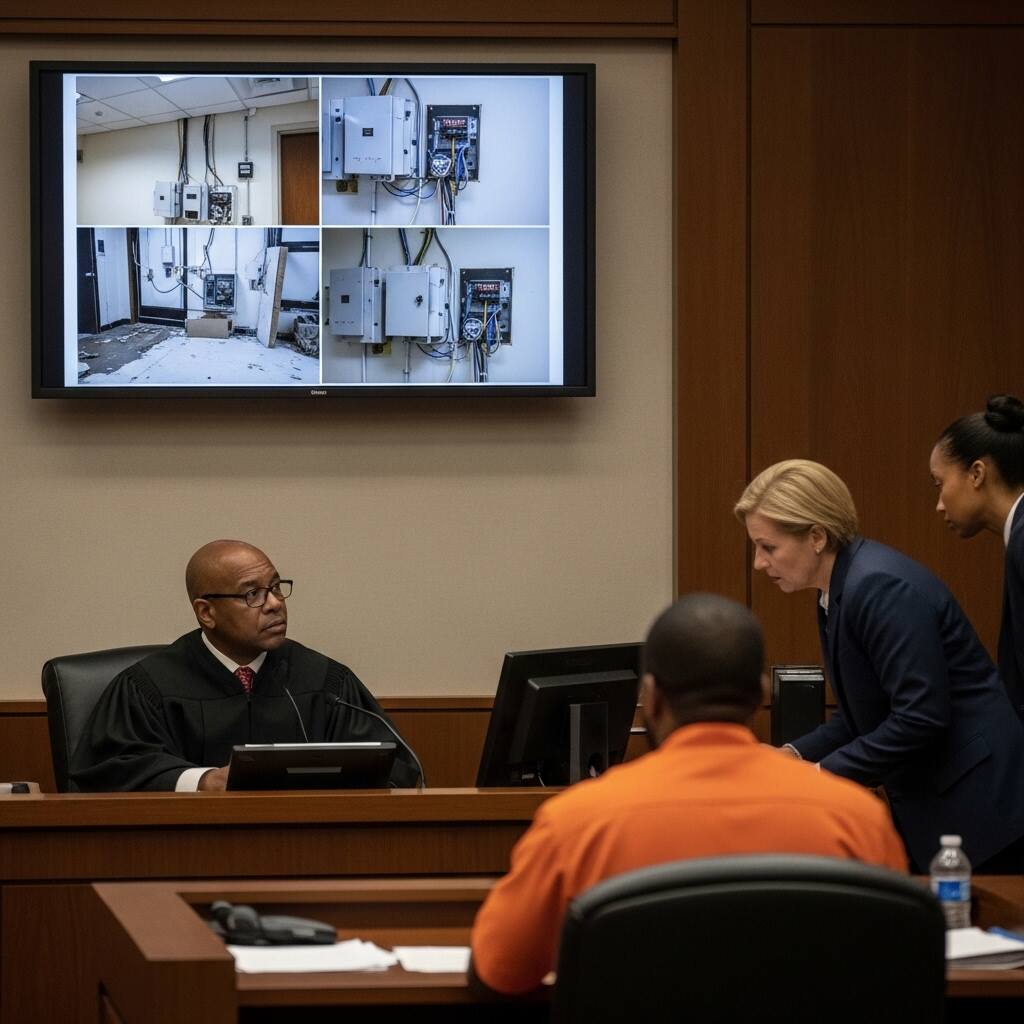
The defense introduced renovation photos into evidence.
Images of exposed wiring.
Removed alarm panels.
Empty brackets where pull stations once hung.
The jurors studied them carefully.
“This renovation was completed four months before the incident ” the defense attorney said. “Inspection passed. No active alarm system.”
The prosecution objected weakly.
“Smoke was observed.”
“Observed by whom?” the defense asked.
The fire captain was recalled.
He testified that when units arrived no active fire was found.
“Was the building evacuated?” the defense asked.
“No.”
“Was there an alarm sounding?”
“No.”
The silence became heavier.
The prosecution had relied on the idea of chaos. Confusion, distraction, evacuation.
The responding fire department had found nothing active.
No flames.
No triggered alarm.
Just a call.
The Timeline Breaks
The prosecution’s narrative depended on a window of distraction created by the alarm.
That distraction supposedly allowed the defendant to enter an area unnoticed.
If there was no alarm…
Then there was no chaos.
If there was no chaos…
Then the timeline lost its cover.
The judge leaned forward again.
“Is there any documentation confirming that the defendant left his assigned area at 9:47 p.m.?”
The clerk checked access logs.
“No, Your Honor. Badge access shows no movement.”
The jury’s attention shifted toward the prosecution table.
Because now the question wasn’t whether an alarm sounded.
It was whether the entire premise of distraction was built on assumption.
The Defendant’s Role
The defendant finally spoke again.
“I told them that night there wasn’t an alarm ” he said quietly.
The courtroom remained still.
He wasn’t pleading.
He wasn’t dramatic.
He was stating something
“You can’t trigger something that doesn’t exist.”
The prosecutor stood again.
“Your Honor someone could have manually called emergency services.”
“Yes ” the judge replied. “. That does not create an internal alarm system.”
The distinction mattered.
Because the prosecution’s case described confusion caused by an automated system.
Not a phone call.
The Caller
The defense requested the phone number used to place the emergency call.
The clerk pulled it from dispatch records.
It was unregistered.
Prepaid.
Activated three days before the incident.
Deactivated two days after.
The jury reacted visibly now.
Because that detail felt intentional.
The judge’s voice lowered.
“Was the defendant in possession of a phone?”
The arresting officer answered.
“No, Your Honor.”
“Was any prepaid device recovered?”
“No.”
The silence grew heavy.
The prosecutor didn’t interrupt this time.
Because now the fire alarm wasn’t proof of chaos.
It was proof of a call.
That call came from a device not linked to the defendant.
The Bigger Question
The courtroom shifted from debating whether an alarm sounded…
To asking who needed one to sound.
The defense attorney spoke carefully.
“If someone wanted to create a window of confusion… a false emergency would accomplish that.”
The prosecution objected.
“Speculation.”
The judge nodded.
“Then present evidence.”
None came.
The jurors no longer looked at the defendant the way.
They looked at the structure of the case.
Because when one foundational detail proves false everything built on top of it becomes unstable.
The Session Ends
The judge announced a recess.
As the defendant was escorted out he remained composed.
He didn’t celebrate.
He didn’t look relieved.
Because he understood something
If the alarm didn’t exist…
Then someone invented the emergency.
If someone invented the emergency…
Then the question isn’t what happened during the chaos.
It’s who created it.
Part 2 – A Glimpse
The morning cell tower data was introduced.
The prepaid phone used to call emergency services pinged a tower, than 300 feet from the building at 9:46 p.m.
It also pinged a secondary tower. One that covered the parking structure used by courthouse staff.
The prosecution objected.
The judge overruled.
Surveillance footage from the parking structure was shown to everyone.
At 9:44 p.m. A car that belonged to a facilities supervisor drove into the parking structure.
This was the supervisor who was in charge of the renovation of the building.
The people on the jury leaned forward in their seats.
The defendant just sat there. Did not move.
The question now was not if the alarm was real or not.
The question now was who wanted the building to be empty and why they said it was on fire when it was not.
If the emergency was not real then what, in this case was not true?
[…] The Alarm Didn’t Exist […]
[…] The Alarm Didn’t Exist […]