
The courtroom was steady all afternoon.
Nothing big happened. Nothing exciting. Just people talking and sharing evidence building a case that the prosecution thought was strong. The jurors were paying attention. They were calm writing down small details in their notebooks that might be important later.
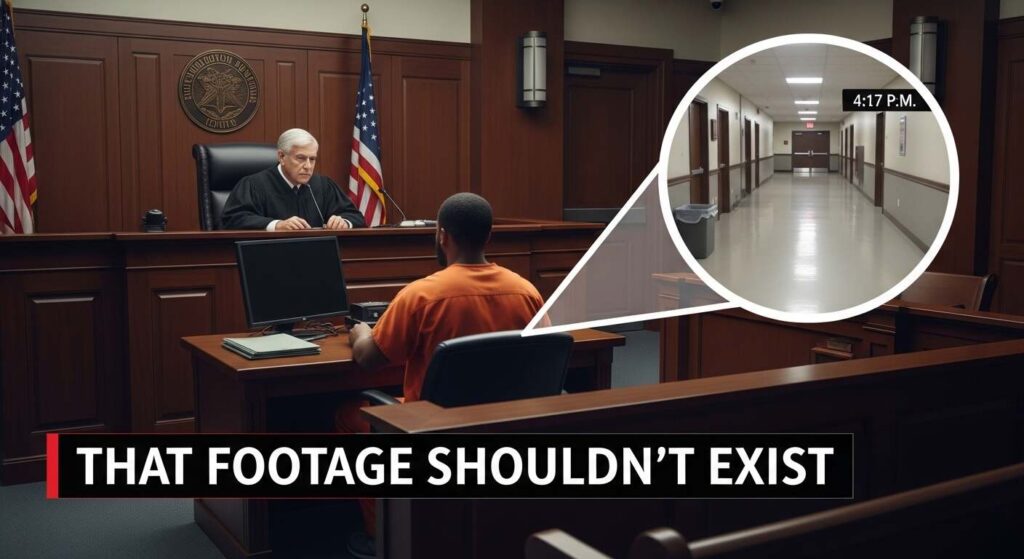
The defendant was sitting at the defense table wearing a jumpsuit.
He did not say much during the trial. He did not interrupt anyone. He did not react when people pointed at him. He was still because he knew that even a small movement could be misunderstood.
When the judge asked to see the footage from the hallway it sounded like a request.
It was routine. The defense had questioned the timeline that morning so the prosecution asked to show the footage to clarify when the defendant was seen near a restricted area.
The lights in the room were dimmed a little.
The monitor turned on. The defendant looked at the screen away. It was the time he had reacted all day.
The clerk started reading from the file.
“Recorded at 4:17 p.m. ” she said. The timestamp was clear on the footage. The jurors looked at each other. 4:17 P.m. Seemed like an reliable time.
The hallway looked empty at first. Then a figure appeared.
The prosecution said this figure was the defendant leaving the courtroom to meet someone.. The defendant said, “Court was still in session at 4:17 p.m.” The prosecutor looked surprised. The judge looked at the defendant sharply. “Explain ” he said.
The defendant said, “We hadn’t finished the session yet. You were still hearing questions.”
The jurors looked at each other. The detail seemed small. It was important. The judge leaned forward. “Clerk confirm the time we stopped for the day ” he said.
The room was completely silent.
The clerk checked the record. “We finished questioning at 4:26 p.m. ” she said. “. We stopped for the day at 4:32 p.m.” The prosecutor looked uncomfortable. The judges face was serious.
If the footage showed someone in the hallway at 4:17 p.m. And court had not stopped until 4:32 p.m. then something was wrong.
The timestamp was wrong or someone was in a restricted area during the session. Neither option was simple.
The hallway in question was not public
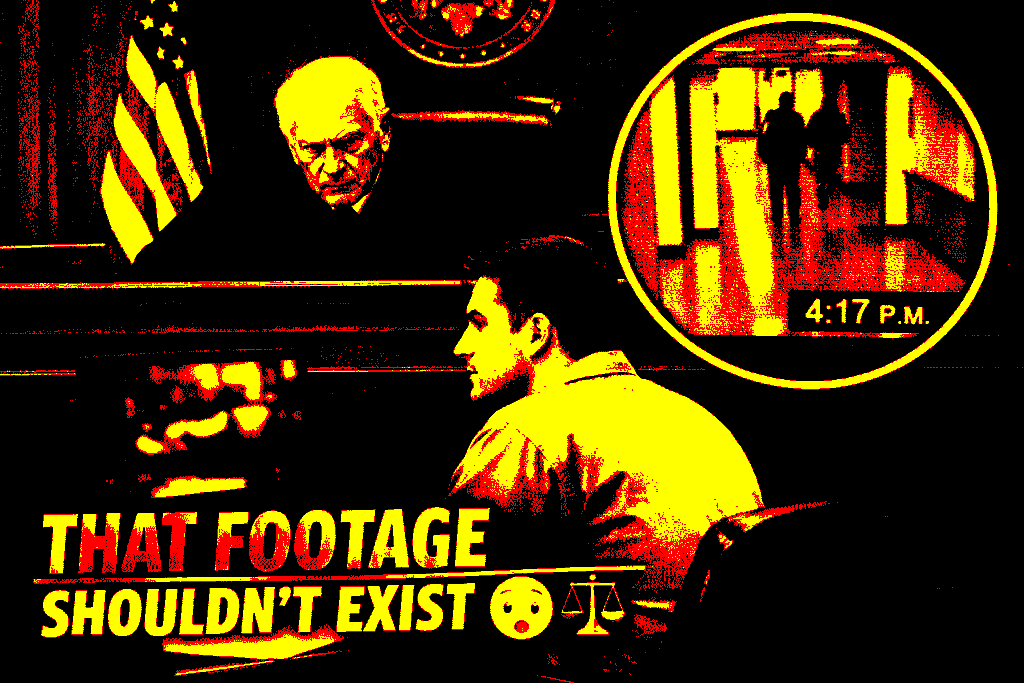
It was only for attorneys, staff and sometimes jurors with supervision. The prosecutor said, “Maybe the cameras clock is a little off.”. The judge asked, “Is the hallway camera synced with the courtroom camera?” The clerk said, “Yes they are all connected to the clock.”
The prosecutor tried again “Maybe someone manually changed the time.”
The judge asked, “Do you have proof of that?” The prosecutor said, “No I don’t.” The jury was watching closely. The defendant did not say anything. He didn’t need to.
The footage was no longer proving what it was meant to prove.
It was raising a question. The judge asked to see the footage slower this time. The figure moved through the corridor for a few seconds. The camera angle was high showing mostly the top of the persons head and shoulder.
The prosecution had said the figure was the defendant. Now timing was more important than identification.
If court was still in session at 4:17 p.m. then where was the defendant? The defense attorney stood up. “Your Honor, at 4:17 p.m. my client was here answering questions. The record will show he responded at 4:18 p.m.”
The clerk checked and said, “That’s correct.”
The implication was clear: the figure in the hallway could not be the defendant. Because at 4:18 p.m. the defendants voice was on record in the courtroom. The prosecutor looked upset. The jurors leaned forward.
The judge said, “If court was in session at 4:17 p.m. And the defendant was on record speaking at 4:18 p.m. then the person in the hallway is not the defendant.”
No one argued. The prosecutions story had fallen apart.. The judge was not finished. “If we didn’t take a break at 4:17 p.m. then no one should have been in that hallway.”
The room felt heavy now
Because this was no longer about proving guilt. It was about explaining something that should not have happened. The judge asked, “Who had access to that hallway at 4:17 p.m.?” The prosecutor sat down slowly.
The footage that was supposed to help his case had done the opposite.
The jurors expressions changed. Before they thought the footage proved something. Now they saw it as a contradiction. The defendant remained calm. Not happy not emotional. Just steady.
Because sometimes the best defense is not loud it’s precise.
A timestamp, a record entry. Two facts that cannot exist together unless something else is wrong. The judge ordered a review of the hallway access logs. The footage would stay as evidence. Not against the defendant. Instead it showed a problem with the procedure.
The courtroom session ended quietly.
No big announcement, no shouting. Just the understanding that something had been assumed quickly. As the defendant was led out he kept his head up. He didn’t look at the jury he didn’t look at the prosecutor. Because he understood something the room was just starting to grasp. That footage should not exist. Not at 4:17 p.m. Not while court was still, in session.
When evidence contradicts procedure it forces everyone to ask a harder question:
If the timing is wrong what else is?