

Objection: Served Hot
The heavy wooden doors of the courtroom swung open with a soft echo that carried across the polished floors. Conversations lowered to whispers. Heads turned.
A young woman stepped inside.
She was only twenty-five, dressed in a perfectly tailored black suit, her posture straight, her expression composed. A leather folder rested under her arm. Her heels clicked against the marble floor in steady rhythm — not rushed, not hesitant.
This was her first high-profile case in federal court.
And everyone knew it.
Across the aisle stood Eleanor Brooks, a respected federal judge known for discipline and zero tolerance for theatrics. The courtroom flag stood tall behind her bench. Jurors quietly observed.
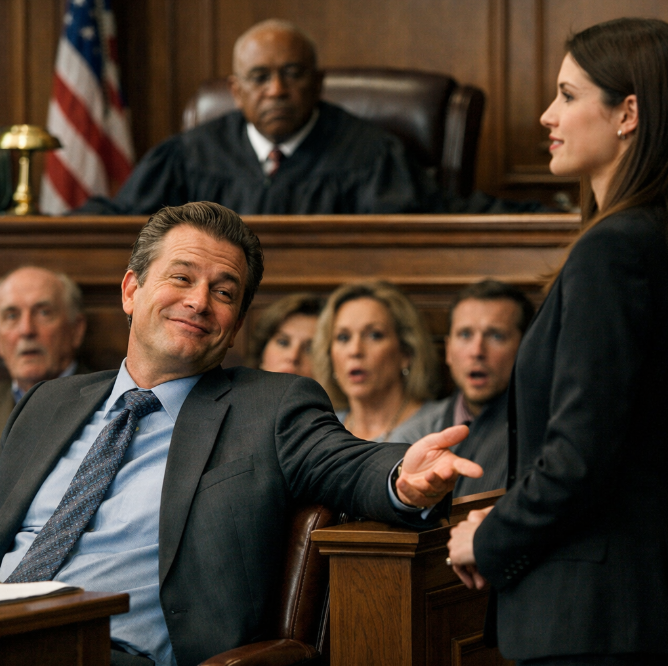
At the defense table leaned a seasoned trial attorney — Richard Holloway — a man in his late forties, famous for dismantling young lawyers with sarcasm before dismantling them with law.
He watched her approach.
Smirked.
And whispered just loud enough for half the courtroom to hear:
“Really? I didn’t know I was in a kitchen and not in a courtroom.”
A short, arrogant laugh escaped him.
A few people in the gallery gasped.
The young lawyer paused.
She turned slowly.
Calm. Unshaken.
Her voice was smooth, controlled.
“Yes,” she said, a faint smile forming. “And on today’s menu… I’ll cook you. Or would you prefer to get fried?”
For a split second, silence.
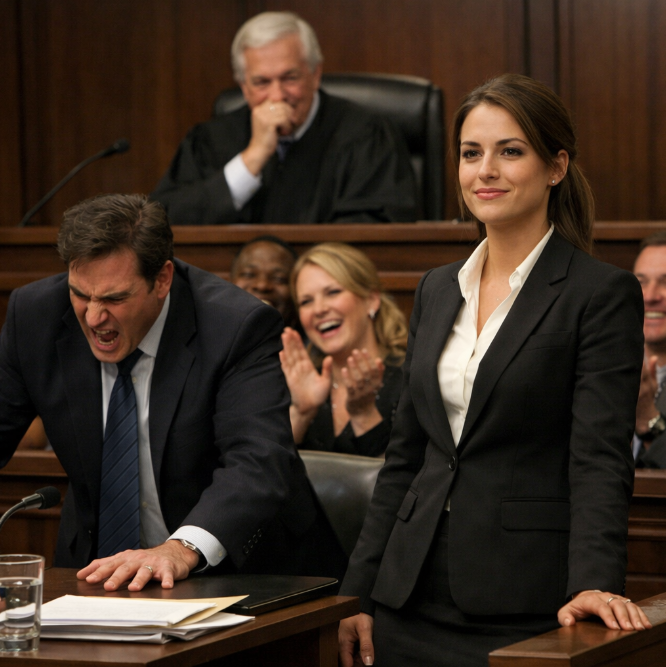
Then laughter burst from the back rows. Even a juror struggled to suppress a grin. Judge Brooks tapped her gavel once, hiding what might have been the smallest smile.
Holloway’s smirk vanished.
He slammed his palm against the table.
“I’ll see you outside the court.”
But she didn’t flinch.
She had already won the first round — not with anger, but with composure.
The Weight of Assumptions
Her name was Amelia Carter.
Graduated top of her class. Law review editor. Federal clerkship. Yet none of that seemed to matter to critics who judged her by age and appearance.
In the weeks leading up to the trial, media headlines were skeptical:
- “Rookie Prosecutor Takes on Veteran Defense Star”
- “Ambition or Arrogance?”
- “Can Youth Win in Federal Court?”
What they didn’t know was this:
- Amelia had studied every page of the 8,000-page case file.
- She had rehearsed arguments until 3 a.m. for weeks.
- She knew Holloway’s courtroom tactics by heart.
- She had mapped every objection he might attempt.
The case involved corporate fraud — millions of dollars siphoned from retirement funds. Elderly citizens had lost life savings.
This wasn’t about ego.
It was about justice.
Round One: Strategy Over Emotion
The prosecution began presenting evidence.
Amelia stood before the jury with steady confidence. She didn’t raise her voice. She didn’t overact. She simply laid out facts.
- Financial records.
- Email correspondence.
- Insider testimonies.
- Audit trails.
Each piece connected seamlessly to the next.
Holloway attempted to interrupt with objections — aggressive, loud, theatrical.
“Speculation!”
“Assumption!”
“Improper foundation!”
But each time, Amelia calmly responded:
“Your Honor, Exhibit 14 clearly establishes foundation.”
“Your Honor, this statement is directly supported by documented evidence.”
Judge Brooks overruled him repeatedly.
Holloway grew visibly frustrated.
The jury noticed.
Confidence isn’t volume.
It’s preparation.
The Cross-Examination That Changed Everything
Midway through the trial, Amelia called the company’s former accountant to the stand.
The man looked nervous.
Holloway leaned back, confident. He assumed the witness would collapse under pressure.
But Amelia approached gently.
“Mr. Lawson,” she began, “how long did you work at the company?”
“Eleven years.”
“And during those eleven years, were you instructed to adjust reports?”
“Yes.”
“By whom?”
The courtroom air tightened.
The witness swallowed.
“By the defendant.”
Gasps rippled across the room.
Holloway jumped up.
“Objection!”
“Overruled,” Judge Brooks said firmly.
Amelia didn’t celebrate. She simply nodded and continued.
She guided the witness step-by-step, allowing the truth to unfold naturally.
Her strategy was clear:
- No intimidation.
- No theatrics.
- Just clarity.
- Just truth.
And the jury leaned forward, listening carefully.
Breaking the Arrogance
The following day, Holloway attempted to regain dominance. During his cross-examination, he tried to corner Amelia during a procedural dispute.
He spoke loudly. Dramatically.
“Young counsel clearly lacks the experience to understand federal litigation.”
A murmur ran through the courtroom.
Amelia stood.
Calm.
“Your Honor,” she said, “experience is valuable. But preparation is power.”
She proceeded to cite three federal precedents supporting her procedural motion.
Related Story: That’s My Number… Not My Voice
Case numbers. Dates. Exact language.
Holloway blinked.
He hadn’t anticipated that.
Judge Brooks adjusted her glasses.
“Motion granted.”
The shift in energy was undeniable.
Holloway was no longer the predator.
He was reacting.
Lessons from the Courtroom
What unfolded in that courtroom wasn’t just a legal battle. It was a lesson in leadership and resilience.
Amelia demonstrated powerful truths:
- Composure defeats provocation.
- Preparation silences arrogance.
- Confidence is quiet, not loud.
- Respect is earned through action.
- Bias collapses under evidence.
The jury didn’t care about age.
They cared about credibility.
And credibility comes from mastery.
Closing Arguments: The Final Blow
On the final day, the courtroom was packed.
Reporters filled the back rows. Cameras waited outside.
Amelia rose for closing arguments.
She didn’t pace.
She didn’t dramatize.
She spoke directly to the jury.
“This case is not about personalities,” she began. “It is about trust. It is about retirement funds earned through decades of work. And it is about accountability.”
She paused.
“When power is abused, the law must respond. Not with emotion. With evidence.”
She methodically summarized:
- The financial discrepancies.
- The accountant’s testimony.
- The internal emails.
- The falsified audit reports.
Each point was clear.
Each conclusion inevitable.
When Holloway stood for his closing, the confidence he once displayed had dimmed. He attempted humor. It didn’t land.
He attempted aggression. It felt forced.
The jury had already seen the difference.
The Verdict
After six hours of deliberation, the jury returned.
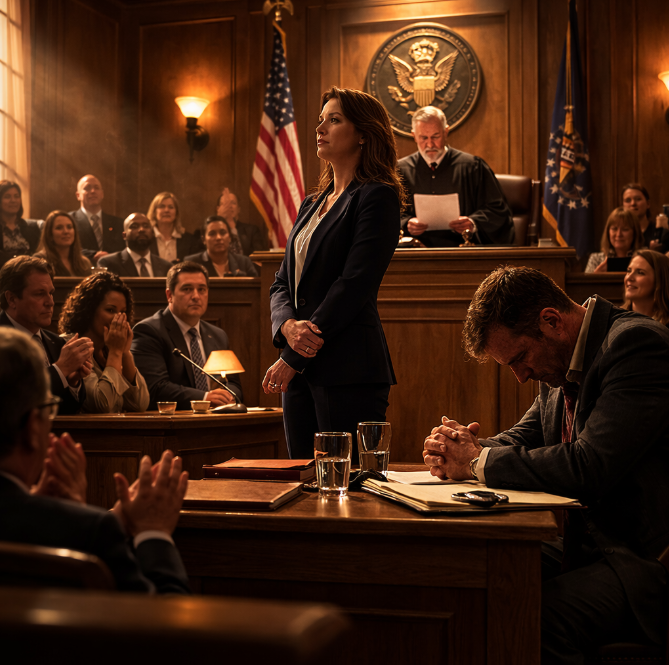
The courtroom stood.
“On the charge of federal financial fraud… we find the defendant guilty.”
The words echoed.
Relief washed across victims seated in the gallery.
Amelia remained composed. She nodded respectfully.
Justice had spoken.
Holloway avoided eye contact.
Outside the courthouse, reporters swarmed.
“Ms. Carter, how does it feel to defeat one of the top defense attorneys in the country?”
She responded simply:
“This wasn’t about defeating anyone. It was about serving justice.”
Beyond the Punchline
Weeks later, clips of the “kitchen” remark and Amelia’s response went viral online.
But what people celebrated wasn’t the comeback.
It was what followed.
Her discipline.
Her intelligence.
Her restraint.
In a world quick to judge:
- She didn’t argue with bias.
- She outperformed it.
- She didn’t demand respect.
- She earned it.
And somewhere in law schools across the country, young women watched that trial and thought:
“If she can do it… so can I.”
Final Reflection
The courtroom is more than a battleground of words.
It is a stage where character is revealed.
Arrogance may draw laughter.
But competence commands verdicts.
On that day, in that federal courtroom, a young lawyer proved something powerful:
You don’t need to shout to be heard.
You don’t need to insult to dominate.
And when someone underestimates you?
Let the evidence speak.
Because sometimes…
The best way to answer mockery is not with anger.
It’s with excellence.