
Courtrooms do not usually fall apart at once. They come undone slowly one detail at a time quietly.
That afternoon everything seemed to be going according to plan. The prosecution had presented its timeline with a lot of confidence. The state said the defendant was seen driving his gray sedan away from the industrial storage lot at around 8:20 p.m. On the night of the incident. This was a piece of evidence. It put the defendant at the scene.
Connected him to the rest of the evidence.
The defendant was sitting at the defense table wearing a jumpsuit. He had not reacted much throughout the morning. He was sitting up straight with his hands folded neatly and his eyes were looking forward. He had listened carefully to every timestamp the prosecution had introduced.
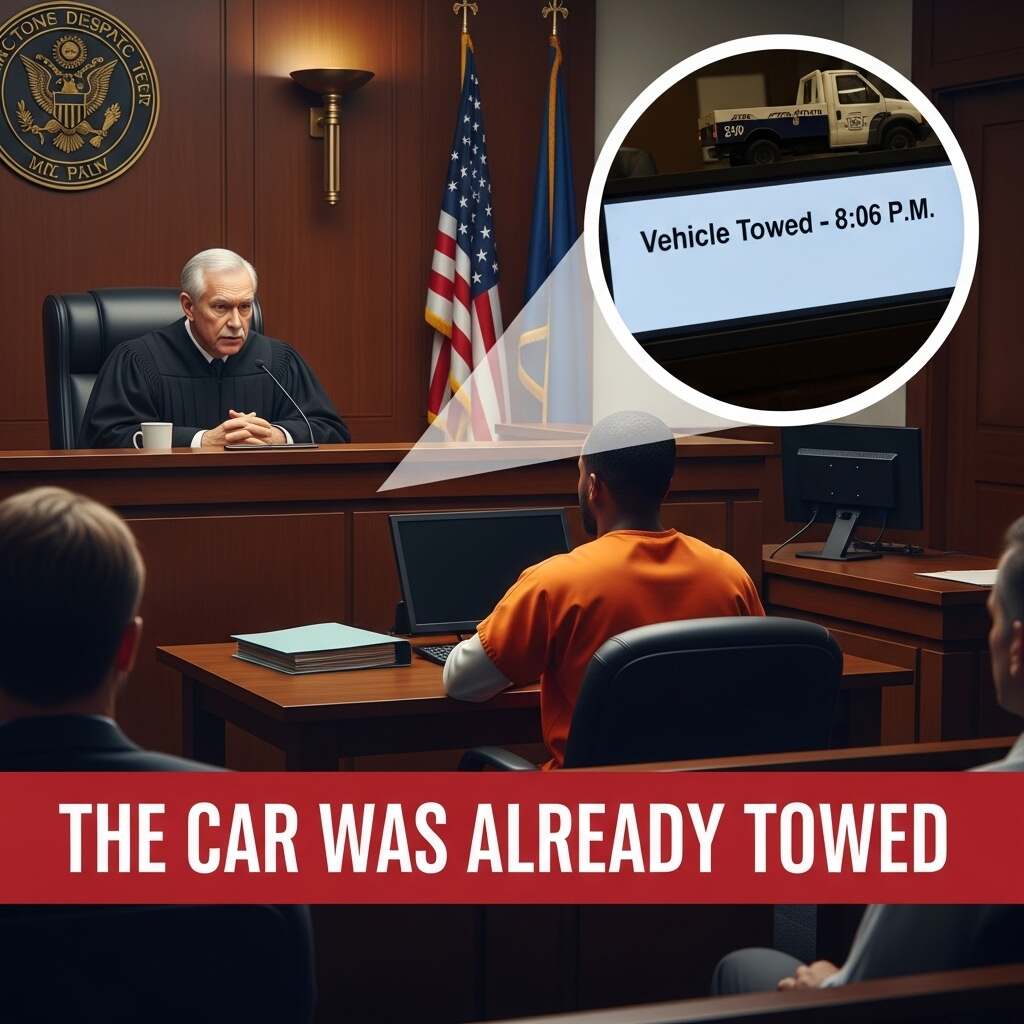
When the judge cleared his throat and said, “Clerk please read the tow truck dispatch record into the record ” it sounded like a request. It sounded like administrative work.
The courtroom monitor flickered as the clerk opened the towing database. The defendant looked up away. Not quickly not defensively just alert.
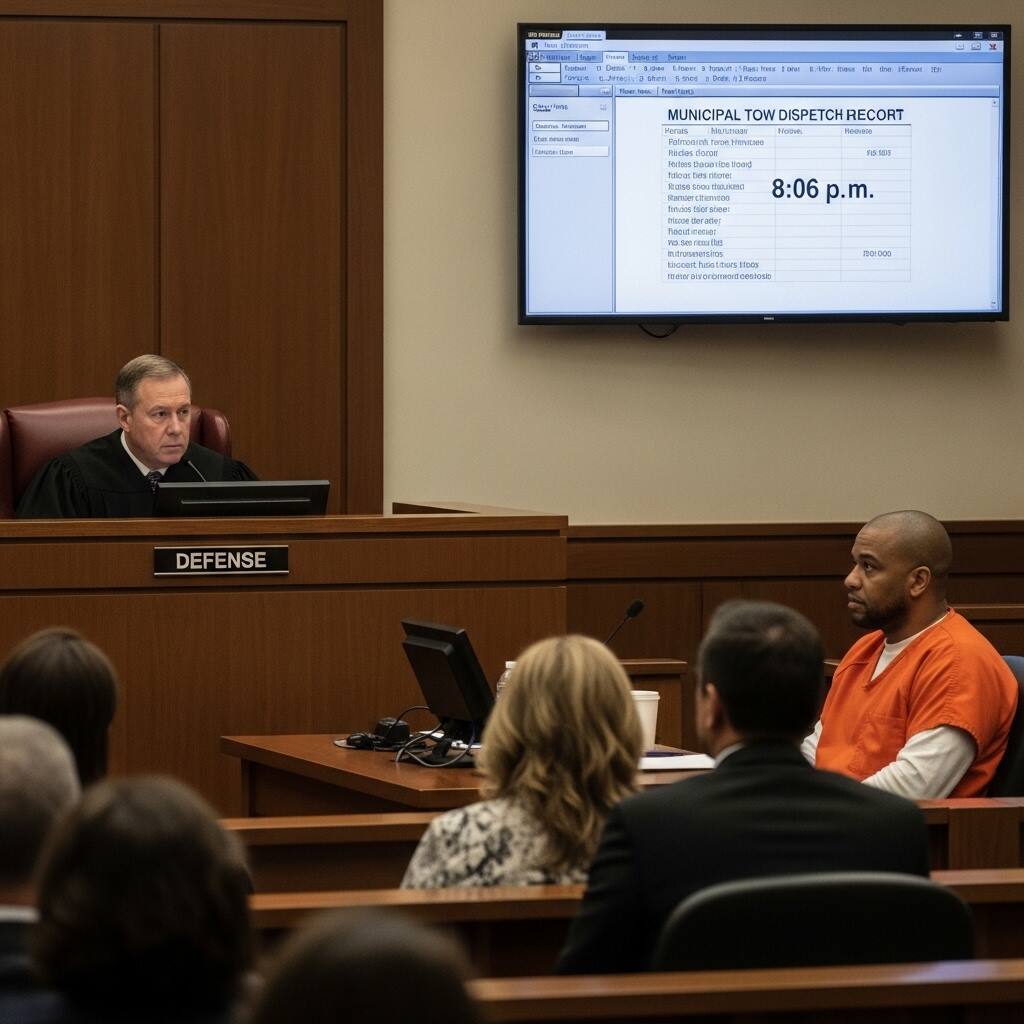
The clerk read clearly “Vehicle towed at 8:06 p.m.” A quiet murmur moved through the jury box. 8:06 P.m. The prosecutor adjusted his jacket.
He did not say anything.
For a second the room was silent holding onto that timestamp. Then the defendant spoke. His voice was low and controlled. “The police say I drove it at 8:20 p.m. ” he said.
The prosecutor stiffened. Pens stopped moving. The judge leaned forward. “Repeat that ” he said. The defendant kept his eyes on the judge. “The report says I was seen driving the vehicle at 8:20 p.m.. It was already towed at 8:06 p.m.”
The air in the room changed. Because timelines do not allow for overlap. If the car was physically loaded onto a tow truck at 8:06 p.m. then it could not have been driven fourteen minutes later.
Unless one of those records was wrong.
The judge said sharply “Clerk please confirm the tow yard receipt.” The silence that followed felt heavier than any objection.
The clerk scrolled deeper into the towing database. “Dispatch request logged at 7:52 p.m. ” she read. “Tow truck arrived on scene at 8:02 p.m.” “Vehicle. Removed at 8:06 p.m.” The judge looked toward the prosecutor. “Is the 8:20 p.m. Sighting the basis for the defendants alleged movement?”
The prosecutor stood up carefully. “It is corroborated by Officer Reynolds testimony.” Officer Reynolds had testified earlier that he saw the defendants vehicle leaving the lot at 8:20 p.m. heading northbound.
The judge turned back to the clerk. “Was the tow yard intake recorded?” “Yes, Your Honor.” “What time?” The clerk checked the system. “Vehicle scanned into tow yard at 8:18 p.m.” Another murmur passed through the jury. That was precise. Tow trucks do not teleport. If the vehicle was scanned into the yard at 8:18 p.m. then it had to be physically present there.
The defendant remained still. He did not smile. He did not lean back. Because this was not a victory. It was a contradiction.
The defense attorney stood calmly. “Your Honor may we establish distance?” The judge nodded. The clerk pulled up a city map. “The industrial lot is 3.7 miles from the tow yard ” she said. The defense continued. “What is the average travel time?” “Ten to twelve minutes.” The math settled quietly over the room.
If the vehicle left the lot at 8:06 p.m. it would arrive around 8:16 or 8:18. Which aligned perfectly with the tow yard intake scan. Meaning the vehicle was already secured and in transit at the time Officer Reynolds claimed to have seen it being driven at 8:20 p.m.
The prosecutor cleared his throat. “Officer Reynolds may have misjudged the time.” The judge raised an eyebrow. “By fourteen minutes?” The prosecutor hesitated. “Possibly.”. The jury had heard the tone. Possibly is not certainty.
The judge ordered Officer Reynolds back to the stand. He appeared composed but uneasy. “Officer ” the judge began “you testified that you observed the defendant driving his vehicle at 8:20 p.m. Is that correct?” “Yes, Your Honor.” “How did you determine the time?” “I checked my patrol dashboard clock.” “Is that clock synchronized with dispatch logs?” “Yes.”
The defense attorney approached slowly. “Officer, were you aware that the vehicle was towed at 8:06 p.m.?” “I was not.” “If the tow record shows removal at 8:06 and yard intake at 8:18 how do you explain seeing the vehicle at 8:20?” The officer shifted slightly. “It could have been a vehicle.” The jury reacted visibly now. Earlier the officer had testified with confidence that he recognized the defendants car specifically.
Now it was “similar.”
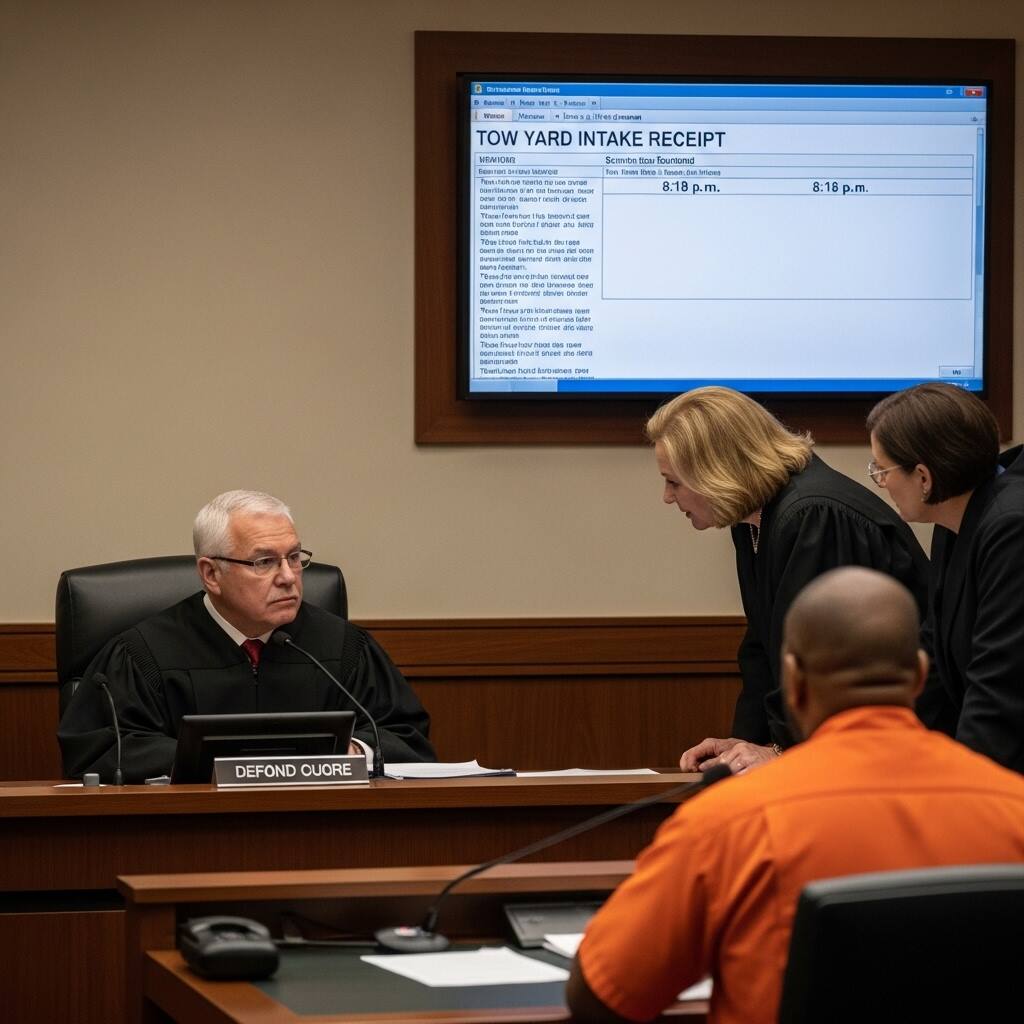
The defense pressed gently. “You noted the license plate in your report ” “Yes.” The clerk checked the report. “Plate recorded as K7D-914.” The clerk then read from the tow yard intake. “Vehicle plate scanned as K7D-914.” The room fell quiet. The numbers matched. The judges voice was steady. “Officer are you suggesting the tow record is inaccurate?” “No, Your Honor.” “Then how did you see a vehicle that was already secured on a tow truck?”
The officer had no answer.
The prosecutions case leaned heavily on that 8:20 p.m. Sighting. It placed the defendant in control of the vehicle after a confrontation.. If that sighting was impossible then the structure built around it weakened significantly. The defendant finally spoke again. Calmly. “I told them to check the tow time.” The jurors looked toward him. Not with sympathy. With attention. Because attention in a courtroom shifts like gravity.. Gravity had moved.
The judge turned toward the prosecutor. “Does the state have any explanation reconciling the tow record with the officers testimony?” The prosecutor chose his words carefully. “Your Honor it is possible the vehicle was temporarily released or misidentified.” The judges tone hardened slightly. “Is there documentation of release?” “No.” “Is there documentation of a vehicle with identical plate?” “No.”
The defense attorney stood. “Your Honor this is not a discrepancy. The timeline is binary.. The vehicle was towed at 8:06 or it was being driven at 8:20. It cannot be both.” The courtroom felt heavier now. Because jurors understand something.
Cars cannot be in two places at once.
The judge ordered the tow truck driver to testify. He appeared straightforward. “I hooked the vehicle at 8:04 p.m. ” he said. “Secured by 8:06.” “Did anyone approach you during removal?” the defense asked. “No.” “Was the vehicle operational?” “No. Front axle damage. Couldn’t be driven safely.” That detail settled like weight. Front axle damage. Meaning even if someone tried the vehicle couldn’t have been driven normally.
The prosecution said nothing. Because now the timeline wasn’t just strained. It was fractured.
The judge leaned back slowly. “This court is not concerned with variance ” he said. “We are concerned with contradiction.” The jurors nodded subtly. Because the contradiction was structural. If the 8:20 sighting was wrong then:
- The officer’s identification was flawed.
- The timeline of movement was flawed.
- The defendant’s alleged presence at the location was unsupported.
The defendant remained steady. He hadn’t argued. He hadn’t raised his voice. He had simply pointed at time.. Time does not bend easily.
The judge called for recess. The courtroom did not buzz loudly. It did not erupt. It shifted. Quietly. As the defendant was escorted out he kept his eyes forward.
Because sometimes the loudest defense is not denial. It is arithmetic. 8:06 P.m.. Towed. 8:18 P.m.. Yard intake. 8:20 P.m.. Alleged sighting. One of those cannot be true.. If one is false… What else might be?
The morning dispatch radio logs were introduced. At 8:19 p.m. Officer Reynolds radioed in: “Vehicle matching description heading northbound.”
Matching description. Not confirmed plate. The defense then introduced bodycam footage timestamped 8:21 p.m. The officer was stationary. No vehicle, in sight. The prosecutor objected. The judge overruled.
Then traffic camera footage
[…] The Car Was Already Towed […]
[…] The Car Was Already Towed […]