

The Envelope No One Expected
The courtroom had been moving with quiet certainty all morning.
Every voice had been heard. Every document had been reviewed. Weeks of careful testimony had slowly guided the trial toward what seemed like an inevitable conclusion.
Sunlight filtered through the tall federal windows, laying soft rectangles of light across polished wooden floors. Spectators sat in attentive silence, sensing the nearness of a final decision. The jurors, tired but focused, watched the front of the room with steady patience.
At the center of it all sat the judge—calm, composed, and prepared to close the final chapter of the case.
Across the courtroom, the defendant waited in stillness.
His expression revealed nothing. No fear, no relief—only a quiet patience that felt unusual for someone standing so close to judgment.
Everything appeared ready to end.
Until something small changed.
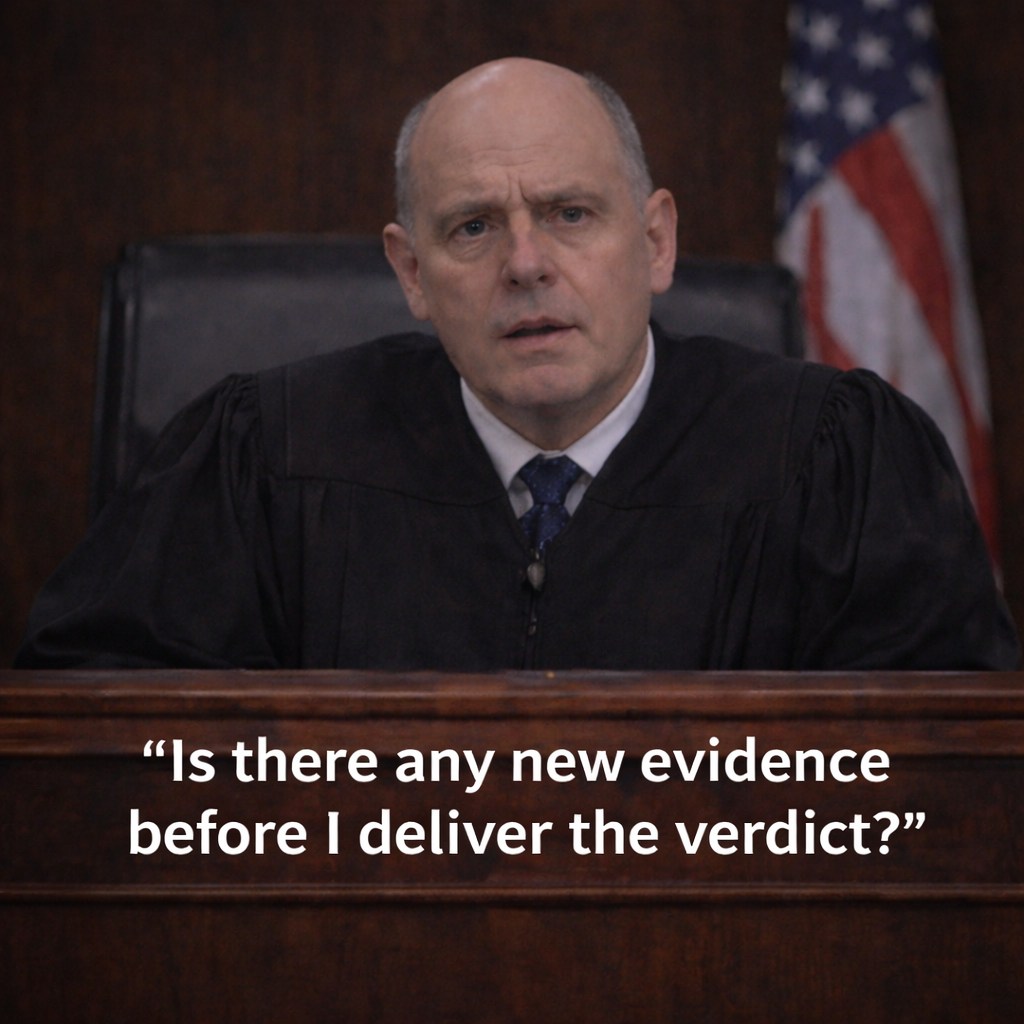
A Question Before the Verdict
The judge inhaled slowly, preparing to speak the words that would carry final weight.
“Is there any new evidence before I deliver the verdict?”
His tone was firm, formal, and familiar—the voice of procedure reaching its final step.
Silence followed.
No one moved.
No one spoke.
The attorneys remained seated, their files already closed. The jurors watched without expression. Even the air in the room felt still, as though nothing more could possibly happen.
And for a moment, it seemed true.
Then a chair shifted softly near the side of the courtroom.
A court clerk—usually unnoticed in the quiet rhythm of proceedings—rose slowly to his feet. His hands trembled slightly, though he tried to steady them.
“Your Honor…” he said, voice unsteady,
“this was found just now.”
Every head turned toward him.
In his hands was a small sealed envelope.
Nothing remarkable in appearance.
Plain. Simple. Ordinary.
Yet the way he held it made the room feel different.

The Photograph Inside
The judge accepted the envelope carefully.
Even the smallest motion seemed louder in the silence.
For a brief second, he simply looked at it—measuring not the object itself, but the moment it represented. Trials are built on timing, and anything arriving at the final instant carries unusual weight.
Slowly, he opened the seal.
Paper slid softly against paper.
From inside, he removed a single photograph.
At first, his expression did not change.
Then his eyes focused more closely.
And something shifted.
It was subtle—so small that only the most attentive observer might notice. But in a courtroom, even the smallest change in a judge’s expression can reshape the entire atmosphere.
A quiet murmur began among the spectators before fading again into silence.
The judge looked at the photograph once more.
Then he lifted his gaze.
Not toward the defendant.
But toward someone else in the room.
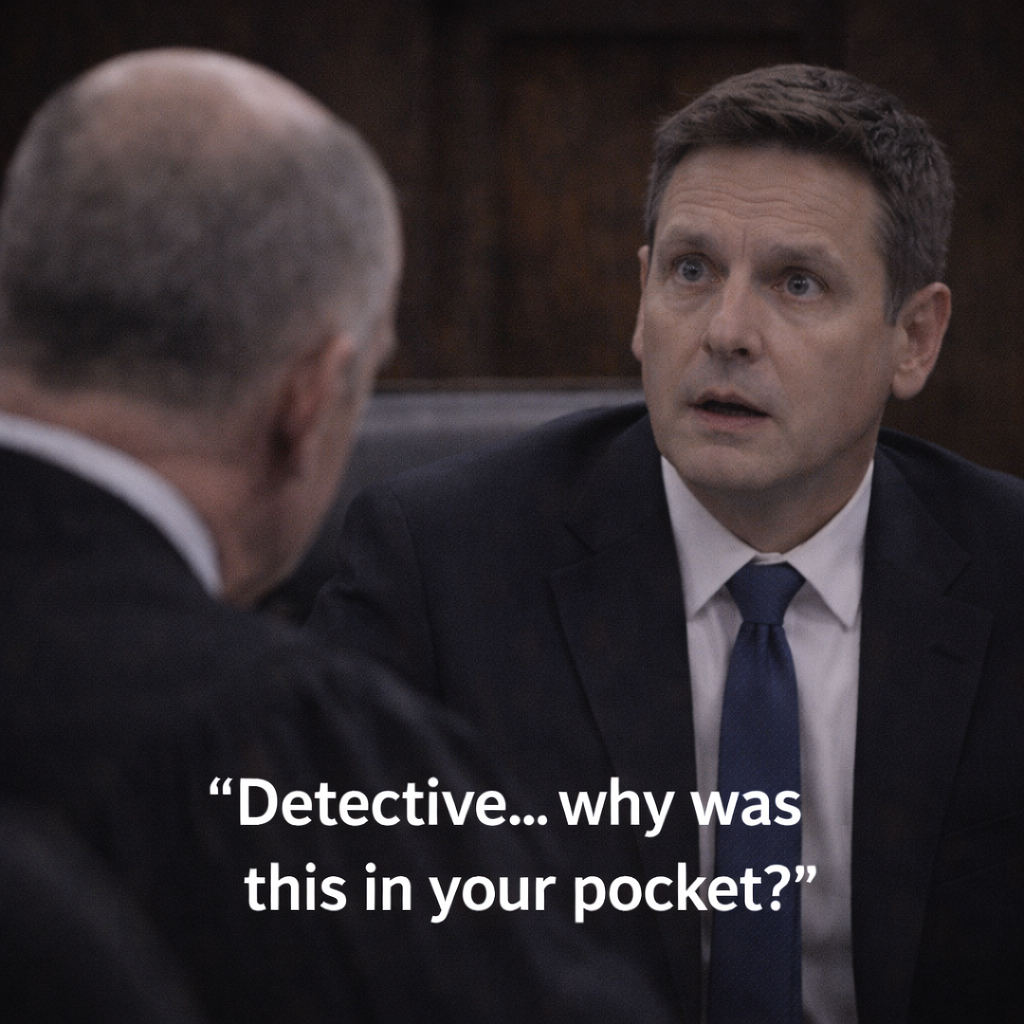
When Attention Turns Unexpectedly
The direction of the judge’s eyes carried meaning before any words were spoken.
They settled on the lead detective seated a few rows away.
The detective, who had appeared calm throughout the trial, straightened slightly under the sudden attention. His expression remained controlled, professional—but something uncertain flickered beneath the surface.
Around the courtroom, confusion spread quietly.
Why look there?
What did the photograph show?
What had changed?
No one yet understood.
The judge studied the detective for several long seconds, weighing the significance of what he had just seen. Years on the bench had taught him patience—especially when truth appeared in unexpected ways.
When he finally spoke, his voice was calm… but colder than before.
“This photograph was taken…”
he paused briefly,
“after the evidence was officially logged.”
The sentence settled heavily into the room.
Because timing, in a courtroom, is never a small detail.
A Silence Filled With Meaning
No one interrupted.
No one dared to guess.
The stillness deepened, thick with questions waiting to be answered.
The judge continued, his tone measured and precise.
“Detective…” he said slowly,
“why was this in your pocket?”
The words were quiet.
Yet they carried farther than any shout.
For a moment, nothing happened.
The meaning needed time to exist.
A spectator shifted in their seat.
One juror exchanged a glance with another.
An attorney’s pen slipped from their fingers and rolled softly across the table.
At the center of it all, the detective remained still—caught between explanation and silence.
Across the room, the defendant watched quietly, the same calm patience resting on his face. Not triumph. Not relief. Only waiting.
Because sometimes the most powerful moments in a courtroom are not loud revelations—
but quiet questions that cannot be ignored.
When Truth Demands a Pause
The judge did not rush forward.
Justice, he knew, is not measured by speed but by certainty.
Carefully, he placed the photograph on the bench before him.
“This court will pause proceedings,” he said evenly,
“to review this new evidence in full.”
It was not a conclusion.
It was not an accusation.
It was something far more important:
A commitment to truth.
Around the courtroom, people slowly began to breathe again. The clear path that once led directly to a verdict had disappeared, replaced by uncertainty—but also by possibility.
Because when new questions appear, fairness requires patience.
And patience is where real justice begins.
The Moment That Changed Everything
Long after the courtroom emptied, people would remember the quiet arrival of a simple envelope.
Not dramatic.
Not loud.
Not expected.
Yet powerful enough to reshape the direction of an entire trial.
It was a reminder that truth does not always arrive early.
Sometimes it waits until the final moment—
when everyone believes the story is already finished.
And when it does arrive,
the only honest response
is to stop…
listen…
and begin searching again.
Key Takeaways
- Justice depends on careful review, not rushed conclusions.
- Small details—like timing—can change everything.
- True fairness requires the courage to pause when new truth appears.
- Calm questions are often more powerful than loud accusations.
- The search for truth is the foundation of every courtroom decision.